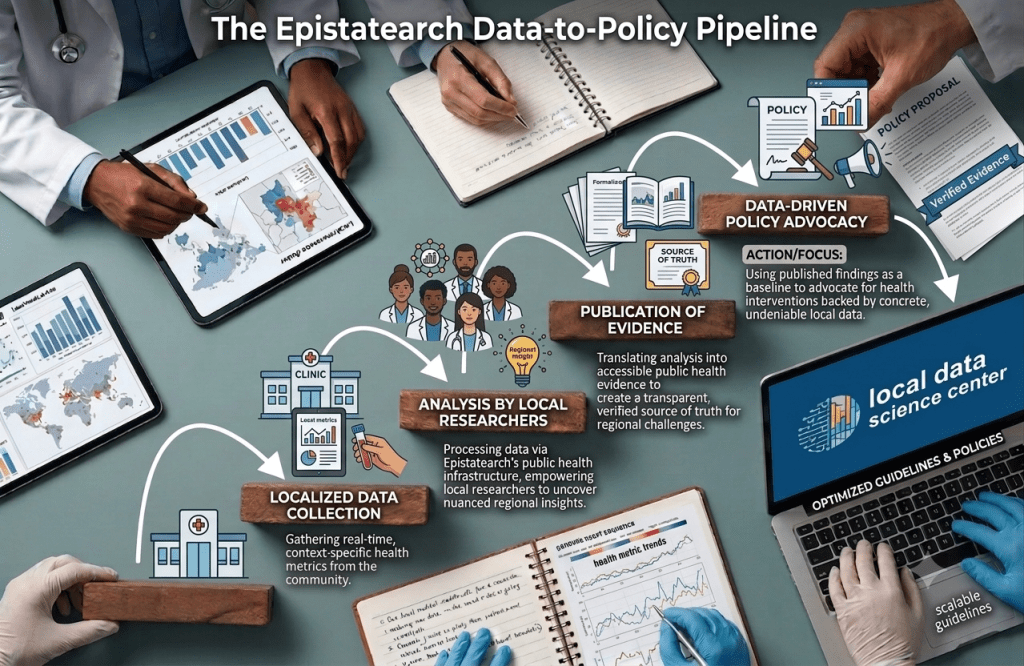
1. Localized Data Collection
The process begins at the frontline. By gathering context-specific, real-time health metrics directly from community clinics and primary care settings, we capture an accurate, unvarnished picture of local health trends as they emerge.
2. Analysis by Local Researchers
Raw data requires contextual understanding. Local researchers process these metrics through public health analytical tools. Their proximity to the community allows them to interpret subtle patterns that external models might overlook, ensuring the insights remain culturally and regionally aligned.
3. Publication of Evidence
Findings are translated into clear, transparent public health evidence. Establishing a verified, locally owned source of truth guarantees that researchers, community leaders, and policy teams share a common foundation of facts.
4. Data-Driven Policy Advocacy
With verified evidence established, advocacy shifts from speculative arguments to concrete proposals. Policy briefs grounded in local data provide decision-makers with clear, undeniable justification for targeted interventions.
5. Optimized Guidelines & Policies
The pipeline concludes with the deployment of tailored, scalable guidelines. These policies reflect real-world community realities, fostering grassroots trust and leading to measurable improvements in health outcomes.
 Epistatearch Company Ltd.